|
|
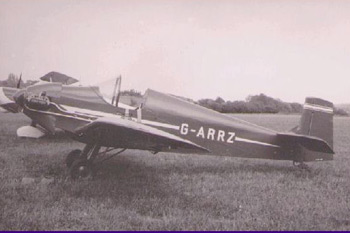
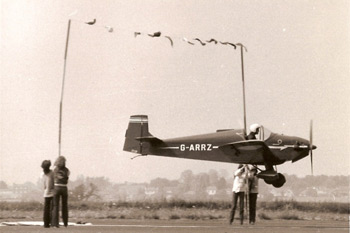
Glider towing with a Turbulent!
Amongst the Club papers the following test report was found. I suspect that this was the kind of adventure dreamed up on a wet winter’s afternoon while sitting in the club room enjoying a cup of tea. Nowadays it is not unknown for microlights to tow gliders but in the early 1960’s, I think this event was somewhat unusual. The following is a full reproduction of the test report as written.
Summary - Rollason/Druine D31 Turbulent G-ARRZ has towed a Swallow glider at an all up weight of 550lbs and climbed at 100 ft/min and 42Kt. to 1,000 ft the elevator and rudder controls are more than adequate to maintain heading and airspeed with the glider out of position by approximately 45° laterally and above the tug, and by 60° below the tug. Power is not considered adequate except for operation under ideal conditions.
A propeller of 4.5’dia and 2.43’ pitch was expected to improve the rate of climb, and was fitted to G-ARRZ. A climb calibration, timed in each case from passing 1,000ft above sea level for one minute, gave these results:-
These results were disappointing, and it was felt that it would not be safe to attempt towing with this performance. A propeller of 4.75’ dia and 2.45’ pitch was fitted, and a climb calibration carried out as above gave these results:-
Towing 840 ft above sea level. Airfield: Runway 05, 6,000 ft long, dry tarmac. Downhill 0.5% gradient - 1 in 200. Wind: 350/4 kts. Glider: Swallow, all up weight 550 lbs. Drag at 45Kt. straight and level 28lbs Tug: Turbulent G-ARRZ 45h.p. all up weight 540 lbs. Propeller 4.75’ dia x 2.45’ pitch. Tug unstuck at 35Kt. just after glider, at about 1000 ft ground run: 60ft reached by 2nd intersection glider released and landed, as arranged. Take off as before, but in opposite direction, to retrieve the glider for further attempt: ground run about 1200ft, glider release at 60 ft. Take off as in (1). Ground run about 1000ft. 60° turn left into wind (4Kt.) to fly over fields suitable for forced landing. Strong thermal activity made climbing erratic and probably reduced overall rate of climb: climbed from 100 ft to 1100 ft in 10 minutes 40 seconds, with prolonged pauses at about 100 ft and 700 ft: climb continued to 1300 ft, where a thermal was contacted: turning at rate 2, climbed rapidly to 1800 ft. IAS was 40-45 Kt. throughout and agreed with glider IAS. Overall rate of climb about 100 ft/min. Tow to 1100 ft altitude as in (3) but without thermal activity: rate of climb again 100 ft/min. Glider flown out of position, as arranged.
At no time did elevator or rudder reach the limit of their travel to maintain heading and airspeed, but with the glider 45° above the tug, there was an excessive nose down attitude which felt uncomfortable but not unstable.
The glider attempted to set up a longitudinal oscillation by using airbrakes to stretch and slacken the rope. This was less noticeable in the Turbulent than it would have been in a Tiger Moth, and airspeed variation was easily kept within 5 Kt. Comments
The glider pilot commented that it was more difficult to hold his position in rough air, as might be expected. The Turbulent can manoeuvre so much more rapidly than a glider, that great caution is necessary in entering turns or altering attitude.
The engine may not have been developing full power, as oil consumption was high, and the front starboard piston rings appeared to have stuck or broken. If the engine developed another 10 h.p. the tug and glider as flown would climb at 300 ft/min more i.e. at 400 ft/min. Out of trim stick force was nose down and of the order of 1lb. Fitting a canopy and spats would decrease drag and increase rate of climb. The flight test was not dated but occurred in early 1962 and took place at Farnborough. The glider pilot is thought to be either Denis or Gordon Crabb.
At the time, it was believed to be the lowest powered aircraft to tow a glider. The Turbulent pilot was Shaun de Salis, he was a very popular pilot in the early years of the Club, sadly he lost his life in a mid-air collision near Limerick, Eire during August 1962 whilst flying a Turbulent. His family donated a trophy to the Club, to be awarded each year in his memory. The De Salis trophy is awarded to the pilot who has done the most for the Club in their first eighteen months of membership.
RRZ crashed in 1989 but the remaining parts were saved and still exist, so maybe it will be rebuilt one day and will join the Turbulent Team again. Photograph Copyright © Ron Smith. |
The Tiger Club 1990 Ltd Office hours 0900 to 1700 Flight booking at |